
If you have been following the news, you will have seen the images. A glacier collapsing near the Nepal-Tibet border. Floodwaters tearing through valleys. And you may be wondering: should I still go to Nepal?
Yes, and here is why.


Our own local team on the ground. Dutch certified. The best of both worlds.
By hiring local guides and porters, you help them earn a good income close to home.
Financially protected through VZR Garant and the Calamity Fund.
If you have been following the news, you will have seen the images. A glacier collapsing near the Nepal-Tibet border. Floodwaters tearing through valleys. And you may be wondering: should I still go to Nepal?
Yes, and here is why.
On August 26, 2026, a massive glacier collapsed near the Nepal-Tibet border, sending ice, rock and meltwater through the Bhote Koshi valley. More than 1,300 people lost their lives. Over 4,200 are still missing, according to the Nepal National Disaster Management Authority.
The affected area is a specific northern corridor. The Nepal Ministry of Foreign Affairs confirmed that the regions most travellers visit — Annapurna, Everest, Pokhara and Chitwan — are entirely outside the disaster zone zone and open as usual.
Adventure travel has always come with surprises and risks. That is part of what makes it an adventure. Climate risks are part of that reality too — in Nepal, as anywhere else in the world. We are aware of that. And we will always be upfront about it, whether you ask or not.
This was not a random event. The Himalayas are warming at nearly twice the global average. Climate change is no longer something that happens far from home. We see it in the extreme droughts and wildfires across Europe, the hurricanes in the Caribbean and the US, the intense monsoons and floods across Asia.
In October 2023, UN Secretary-General António Guterres stood in the Everest region and said: “The rooftops of the world are caving in. Stop the madness.” Barely three years later, his words feel less like a warning and more like a verdict. That is the world your travels take place in. And it is also why your choice whether to come or not , matters more than ever.


Staying away has a price too. One that is less visible, but just as real.
Tourism accounts for 7 to 8% of Nepal’s national income and supports more than one million jobs. Mountain guides, porters, teahouse families, drivers. When travellers stay away from areas that were never affected, the economic damage spreads far beyond the flood zone. Some are already calling it Nepal’s next potential disaster (Kathmandu Post, September 8, 2026).
Tourism Minister Khadak Raj Paudel said it clearly: “Your coming to Nepal this time does not mean only a holiday. It’s a big support to the country fighting this catastrophic tragedy.”
And Nepal is a country that deserves that support. Forest cover has grown from 26 to 46% in three decades, one of the world’s most remarkable conservation stories according to the World Bank. In 2025, 73% of all new cars sold were electric. Only Norway scores higher. A country doing so much right, that lost 10% of its clean energy infrastructure in a single day through no fault of its own.


Yes. And here is why it matters that you do.
Travel can build bridges. Between people and places. Between who you are when you leave and who you are when you come back.
“When people come to Nepal, something happens to them,” says Govinda, our co-founder. “I see it all the time. They arrive with their plans and their schedules, and then the mountains change them. Not because of something we do. But because of what Nepal is.”
In Nepal, climate change is not a concept. It is the landscape you walk through. And that changes you in ways that no documentary ever could.
At By Mountain People, we follow the science and choose our destinations and timing carefully. Our group treks run during the safest seasons: spring (mid-February to May) and autumn (October to November). For tailor-made trips, we talk it through together. And we give you the best possible advice.
That means going with an operator who knows the terrain, pays fair wages and keeps their groups small. And when you get home, let Nepal stay with you.
We would love to be that operator for you.


Let’s be real. There is no such thing as impact-free travel. A long-haul flight to Nepal has a carbon footprint, and we will not pretend otherwise. But staying home is not the answer either. The people of Nepal need travellers like you to come. So, the question is not whether to go. The question is how.
It all starts with awareness. Seeing where you are,, who lives there, and what is at stake. Nepal makes that impossible to ignore. And what you see there, you carry home. In the choices you make, the stories you tell and the things you start to care about.
Nepal is still here. It’s still breathtaking. And still waiting.
And it needs conscious travellers like you now more than ever.
Thinking about visiting Nepal? View our small-scale group trips or plan your own tailor-made trip. We are happy to discuss the options together.
Valerie
By Mountain People

Excited about our trips to Nepal? Reach out via the buttons below. We're ready to help.
Send a Whatsapp message Call us on +31 6 87 54 22 50Not the usual suspects. These three trekking trips show a side of Nepal most travellers never see. These are our favourite treks for a reason.



Exploring and traveling Nepal is super exciting, and can be overwhelming at the same time. Having reliable resources for useful information is useful to prepare your trip and make the most of it. This is why we share our knowledge and insiders information with you here, through our blog.

Now let's make it real. Browse our trips or request a quote. We are a small Nepal trekking company, so you will hear from us personally ASAP.


Our own local team on the ground. Dutch certified. The best of both worlds.
By hiring local guides and porters, you help them earn a good income close to home.
Financially protected through VZR Garant and the Calamity Fund.
Getting altitude sickness in Nepal is quite common. Studies in Nepal’s high mountain regions show that between 30% and 50% of trekkers experience symptoms of acute mountain sickness in Nepal. On the Annapurna Circuit, a recent study found an incidence of 45%. In the Everest region, the figure sits around 30%. So if you are heading above 2,500 metres, the chances are real.
Altitude sickness happens when your body does not get enough oxygen at high altitude. The air contains the same percentage of oxygen as at sea level, but the air pressure is lower. Your lungs take in less oxygen with each breath. Your body needs time to adjust, and that process is called acclimatisation.
Altitude sickness comes in three forms:
For all three, the same rule applies: descent is the best medicine.


Every trek we design above 2,500 metres is built around one principle: give your body time. That is not just our preference, that is what the research shows. A recent study at the Himalayan Rescue Association aid post in Manang found that almost a third of altitude sickness patients had ascended too quickly, more than 500 metres per day above 2,500 metres.
So this is what we do at By Mountain People:
Acute mountain sickness in Nepal is no joke. On my first trek up there, I lost my appetite as we gained altitude. I knew about staying hydrated, but I never heard about eating. I started sharing meals with my best friend, and we thought we were just not very hungry.
Later I learned that loss of appetite is one of the early signs of altitude sickness. I was lucky. Nothing serious happened. But ever since, I make myself eat full portions. Even when I do not feel like it. My body is working hard up there, walking long days, staying warm, processing the altitude. It needs fuel. 🔥
That is why we tell every one of you the same thing: do not skip meals. If the portions feel too big, eat soup and small snacks in between. But keep eating.
Your guide and your team take care of a lot. But your body is yours, and there are things only you can do.
Diamox, also known as acetazolamide, is a medication that helps your body acclimatise faster. It is widely used and well researched.
However, at By Mountain People we do not advise taking Diamox preventively. Because we believe it is important to feel how your body responds to altitude, rather than masking the early signs. If you suppress symptoms preventively, you may miss a warning that something is wrong.
That said, we do recommend bringing Diamox with you on higher-altitude treks. It can be useful to have on hand if descending immediately is not possible, or if symptoms develop and your doctor or guide advises you to take it. Talk to your GP or travel doctor before your trip about what to bring and when to use it.


Altitude is part of what makes Nepal so extraordinary. But you don’t want to get altitude sickness in Nepal. The Himalayas may not be gentle, but they are honest. They reward travellers who pay attention, who listen to their bodies, and who walk with people who know the way.
We have built our treks around exactly that. Acclimatisation days that are not negotiable. Daily distances that fit what your body can handle. Guides who notice things before you do. And a team that has been doing this for over a decade.
If you want to know more about altitude or about a specific trek, just ask. You can reach us by email, meet us at a travel fair, or get in touch through our contact page. We are happy to talk it through.
Disclaimer: This blog provides general information and is based on our experience and on the sources listed above. It is not a substitute for medical advice. If you have questions or concerns about altitude sickness, please contact your GP or a travel doctor before your trip.
Excited about our trips to Nepal? Reach out via the buttons below. We're ready to help.
Send a Whatsapp message Call us on +31 6 87 54 22 50Not the usual suspects. These three trekking trips show a side of Nepal most travellers never see. These are our favourite treks for a reason.
Exploring and traveling Nepal is super exciting, and can be overwhelming at the same time. Having reliable resources for useful information is useful to prepare your trip and make the most of it. This is why we share our knowledge and insiders information with you here, through our blog.
Now let's make it real. Browse our trips or request a quote. We are a small Nepal trekking company, so you will hear from us personally ASAP.
Our own local team on the ground. Dutch certified. The best of both worlds.
By hiring local guides and porters, you help them earn a good income close to home.
Financially protected through VZR Garant and the Calamity Fund.
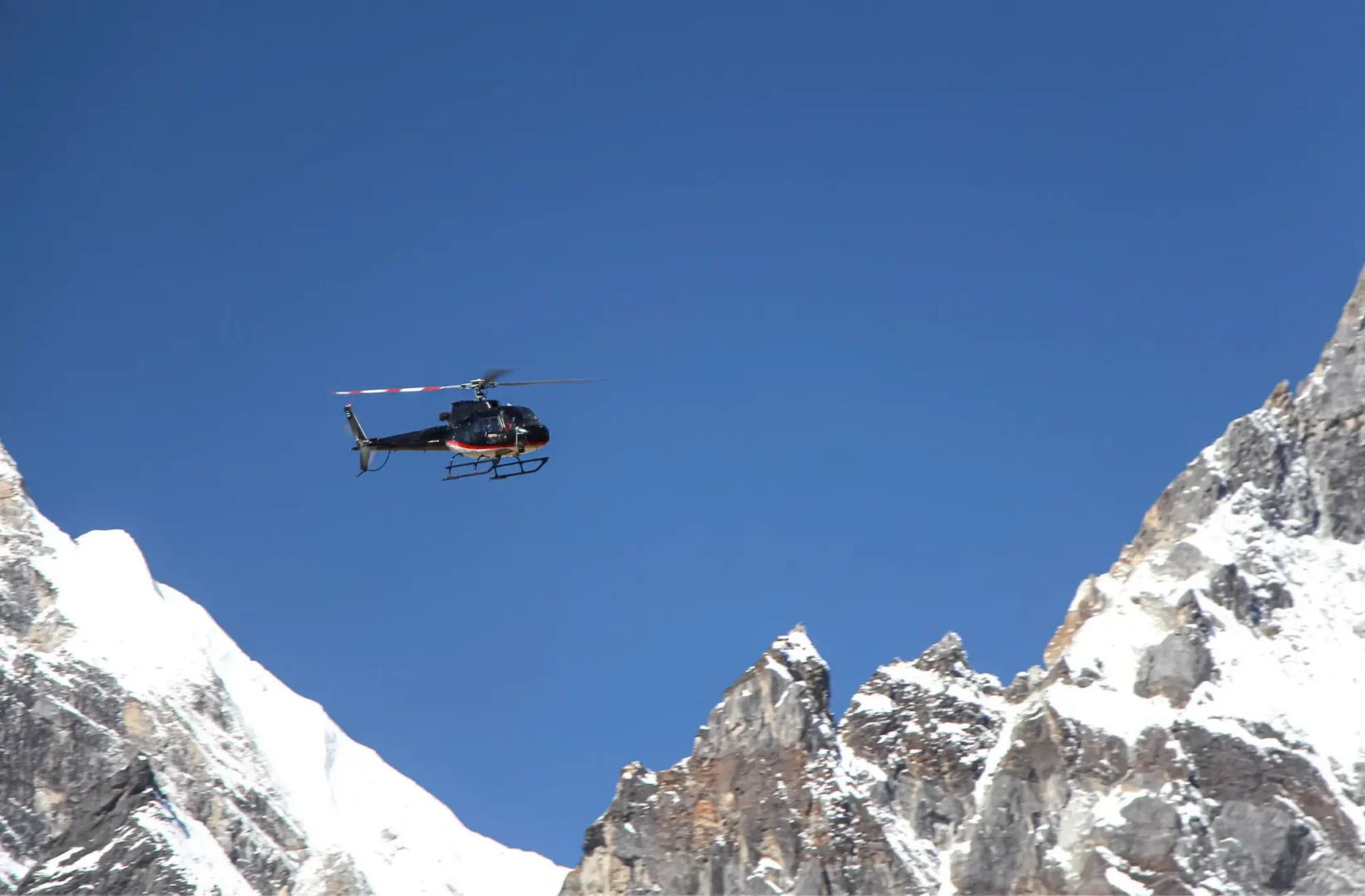
If you’re planning a trek in Nepal, this is something worth knowing. Helicopter rescues happen every trekking season, and not always for the right reasons. If you search online on “helicopter rescue Nepal” you’ll find numerous news articles about early 2026, when nine people were arrested in Nepal for faking helicopter rescues. But the real story goes deeper than the scam itself.
In many cases, an unnecessary evacuation doesn’t start with fraud. It starts with poor planning.
Large groups with only one guide, or climbing to high altitude too fast. Unrealistic itineraries that don’t allow enough time to acclimatise. Groups eating at lodges where hygiene is insufficient, or ordering dishes you simply shouldn’t eat in remote areas. Meat, for example, is often transported on foot to high-altitude lodges, without refrigeration. The risks are real.
The ratio of guides to trekkers matters too. A single guide responsible for a large group cannot monitor everyone closely enough at altitude. When something goes wrong, the pressure to act fast, rather than act right, increases significantly.
When things go wrong in these situations, guides often have only one option: call a helicopter. And that’s where it gets complicated. Some travel organisations own their own helicopters and clinics, and profit directly from every evacuation. In some cases, the rescue wasn’t even necessary in the first place.
One more thing worth knowing: many international travel organisations don’t run their own trips at all. They sell the journey, but hand the execution over to a local operator. And the lines of responsibility become blurred.


There are 5 things you can do:
It’s also important to check your insurance. Not all travel insurance policies cover trekking in Nepal. Some offer limited coverage at higher altitude or in remote areas. Check your policy before you leave, and make sure it explicitly covers high-altitude trekking and emergency evacuation in Nepal.
Most policies define high altitude as above 4,000 or 5,000 metres. Some exclude helicopter evacuation unless it is deemed medically necessary by a certified professional on the ground. Read the fine print before you leave, not after something goes wrong.
By Mountain People is both a local Nepali and a registered Dutch travel company, connected to VvKR (Association of Small-scale Travel Specialists, Vereniging van Kleinschalige Reisorganisaties) and backed by the guarantee fund VZR Garant. That means you have the security of a recognized European travel organisation, combined with the local knowledge and network of a team that has been working in these mountains for years.
We don’t outsource. We have our own execution team in Nepal, are registered at TAAN, with guides and porters we know personally, work with for years and trust completely. Short lines, high standards.
With By Mountain People, you either trek with your own private guide, or join one of our small groups. The group trips are never more than 10 people, and always with two guides when groups are larger. Our itineraries are built around proper acclimatisation, not speed. Before you head into the mountains, your guide checks your gear, briefs you on food safety and makes sure you know what to expect.
In October 2025, an unexpected storm hit the Himalayas in the middle of peak season. Entire areas were closed, flights delayed, rescue teams deployed. At By Mountain People, we had several groups out on the trails at the time. And every single person was brought to safety. Some returned to Kathmandu or Pokhara, others completed their trek via an adjusted route.
Not one of our groups needed a helicopter evacuation. Not during the storm, and not at any point during the rest of 2025.
“Thanks to Govinda’s quick response, we found a new route towards ABC (Annapurna Base Camp).” – Serge
“Govinda had his head on a swivel and facilitated an alternative over the course of one morning, allowing us to experience the awesomeness of the Himalayas, instead of getting stuck in a closed off region.” – Jeffrey


These scams damage the reputation of an entire industry, one that is largely built on honest, hard-working people. The guides who get up before dawn. The porters who carry heavy loads at altitude. The teahouse owners who open their doors to strangers every single day. They deserve better than to be associated with the actions of a dishonest few.
Nepal remains one of the most beautiful trekking destinations in the world. Go well prepared, choose wisely, and you’ll have nothing to worry about.
Curious about how we work? We’d love to tell you more.
Or read more about trekking in Nepal or learn how to recognise and prevent altitude sickness on your trek.
Get in touchExcited about our trips to Nepal? Reach out via the buttons below. We're ready to help.
Send a Whatsapp message Call us on +31 6 87 54 22 50Not the usual suspects. These three trekking trips show a side of Nepal most travellers never see. These are our favourite treks for a reason.
Exploring and traveling Nepal is super exciting, and can be overwhelming at the same time. Having reliable resources for useful information is useful to prepare your trip and make the most of it. This is why we share our knowledge and insiders information with you here, through our blog.
Now let's make it real. Browse our trips or request a quote. We are a small Nepal trekking company, so you will hear from us personally ASAP.