


Our own local team on the ground. Dutch certified. The best of both worlds.
By hiring local guides and porters, you help them earn a good income close to home.
Financially protected through VZR Garant and the Calamity Fund.
In a nutshell
With the group trek across the Annapurna Circuit with Tilicho Lake, we explore one of Nepal’s most varied trekking regions together. Over 20 days, the landscape shifts completely: from subtropical river valleys near Chamje to the vast, wind-swept highlands north of the Annapurna massif. Every day looks different from the one before.
From Chamje, we follow the Marsyangdi River upstream through forests, gorges and stone villages with Tibetan roots. The route climbs gradually. Acclimatisation days in Manang give our bodies time to adjust before the high section begins.
Then comes the detour that sets this trek apart. We leave the main circuit and climb to Tilicho Lake at 4,920 m / 16,138 ft. Ice-blue water, towering rock walls and a silence that stays with you. Most trekkers on the circuit never get here.
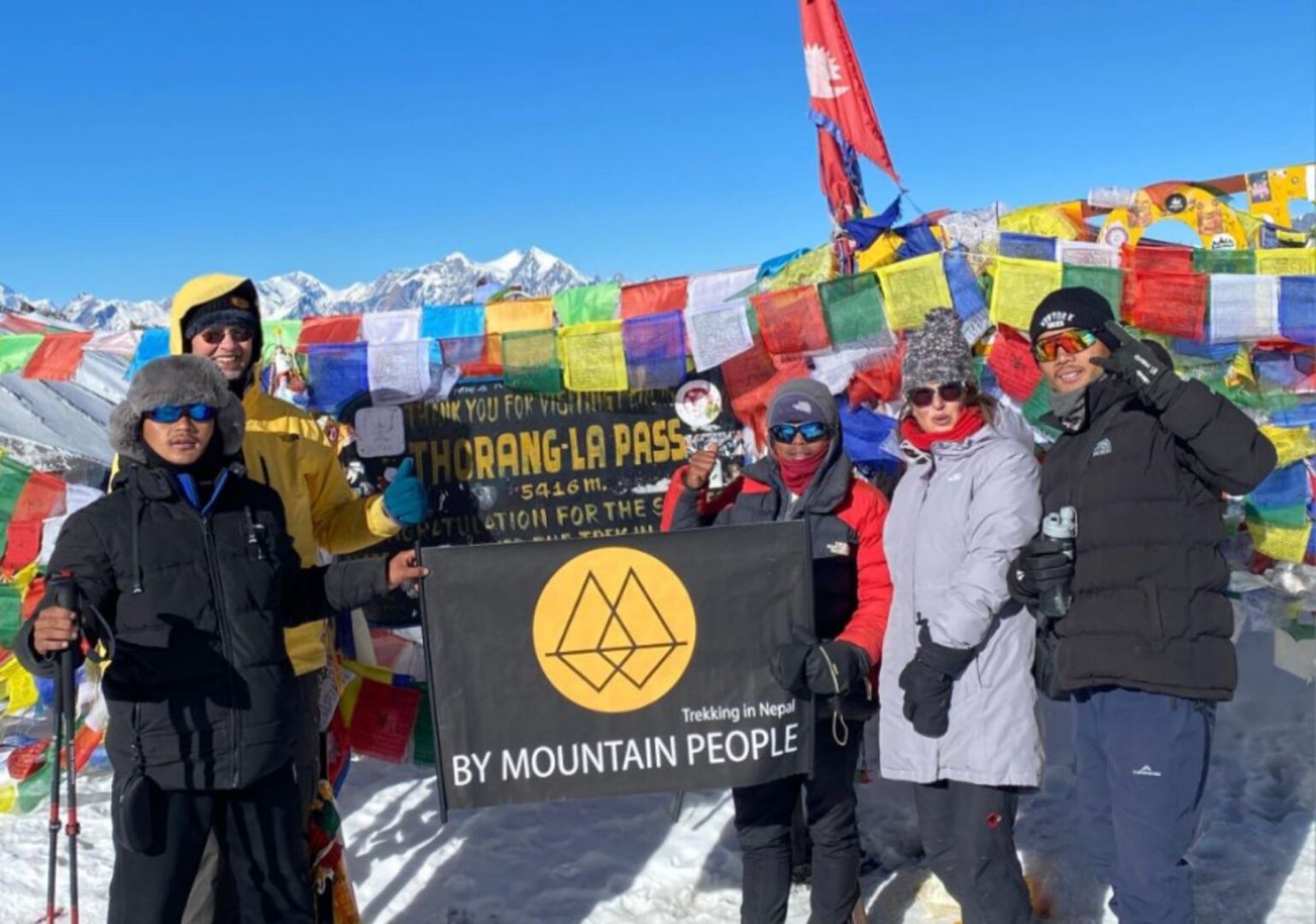
From there, we return to the main route and face the big one: Thorong La Pass at 5,416 m / 17,769 ft, one of the highest trekking passes in the world. We start before sunrise, move slowly and steadily, and reach the summit as prayer flags snap in the wind. The descent to Muktinath is its own reward.
We end in Pokhara, with the Annapurnas reflected in the lake and a bag full of shared memories.


You don’t need to be a top athlete, but this trek does ask something of you. Think 4 to 7 hours of walking per day, several days in a row, at altitude. If you’re used to multi-day mountain hikes, you’ll generally be fine. The hike to Tilicho Lake (4,920 m / 16,141 ft) and the trek over the Thorong La Pass (5,416 m / 17,770 ft) are the most demanding sections.
Not sure? Just get in touch. We’re happy to look at your experience level together and see whether this route suits you.
Yes. You can add days before or after the group trip, in Kathmandu, Pokhara or anywhere else in Nepal. There’s so much more to explore! Get in touch and we’ll build it into your trip.
Absolutely. Most people who join our group trips come on their own. You’ll share the experience with a small group of like-minded travellers and a guide who knows everyone by name.
Yes, that is possible at an extra cost. You’ll find the applicable supplement on the “Pricing & dates” tab.
Our group trip prices are based on shared rooms for two or three people as standard.
Absolutely. Get in touch and we’ll send you a tailor-made price proposal including your flights.
🌳 Four climate zones in one trek
From the subtropical river valleys below 2,000 m to the high-altitude desert above 4,000 m, the Annapurna Circuit passes through four distinct climate zones in a single journey. Subtropical forest gives way to temperate woodland, then alpine meadows, then the vast wind-swept plateau north of the Annapurna range, where the landscape shifts completely and feels closer to Tibet than Nepal.
Pricing & dates
The price of this trip is per person, based on sharing twin rooms.
Prefer your own hotel room in Kathmandu and Pokhara? The single room surcharge is 145 euro.
Included in this trip
- Airport transfer (arrival and departure)
- Comfortable hotel in Thamel, Kathmandu (including breakfast) – 4 nights
- Group dinner on the day of arrival
- Pre-trip meeting and briefing in Kathmandu
- All required trekking permits
- Licensed English speaking trekking guide (salary, transport, accommodation, meals, gear and insurance)
- Experienced mountain porter (salary, transport, accommodation, meals, gear and insurance)
- Transfer from Kathmandu to the trailhead
- All teahouse accommodation during your trek – 13 nights
- Breakfast, lunch and dinner during the trek

- Transfer from the trek endpoint to Pokhara
- Comfortable hotel in Lakeside, Pokhara (including breakfast) – 2 nights
- Bus from Pokhara back to Kathmandu
- 24/7 support from the By Mountain People team throughout your trip
- Booking secured through the Calamity Fund
- Booking secured through VZR Garant
- VAT and tourist service charge

Not included
- Any hot and cold drinks
- Insurance covering rescue and evacuation
- Tips
- All other expenses not listed under 'Included'
| Date | Availability | Participants | Price p.p. | |
|---|---|---|---|---|
| Thu, 19 Nov 2026 | Full | from 1,988 EURO | Join this group | |
| Sat, 13 Nov 2027 | Available | View | from 1,988 EURO | Join this group |
Day-to-day program
This page shows you how the Annapurna Circuit Group Trek with Tilicho Lake is structured, day by day.
Note: walking times are indicative and depend on the walking pace.
You land at Tribhuvan International Airport. Your guide is waiting outside arrivals and takes you and the rest of the group directly to the hotel. The drive takes about 20 to 30 minutes, depending on traffic.
In the evening, the group heads out for dinner together. A great moment to meet each other and get to know one another. Welcome to Nepal. 🙏🏽


Time to rest, adjust and prepare. Today is the pre-trip meeting. Together with your guide and group, you go through the itinerary and check that everyone has the right gear. Missing something? No problem. The streets around your hotel are lined with outdoor shops.


Sightseeing
Want to go for a small walk in the afternoon? Here are some ideas on walking distance from your hotel.

Swoyambhunath Stupa
Also known as the Monkey Temple, Swayambhunath sits on a hilltop about 20 minutes west of Thamel. The climb up the stone staircase is steep, but the reward is a panoramic view over Kathmandu and a stupa surrounded by dozens of resident monkeys. The all-seeing eyes painted on the tower watch over the city from every angle. One of the oldest religious sites in Nepal, revered by both Hindus and Buddhists.

Kathmandu Durbar Square
About 15 minutes on foot from Thamel, Kathmandu Durbar Square is the historic heart of the old city. The square was the seat of the Malla and Shah kings for centuries and is still used today for religious ceremonies, including those of the Kumari, the living goddess whose residence is located within the complex. The temples, courtyards and wooden carvings date back to the 15th and 16th centuries. Some structures are still being restored after the 2015 earthquake, but the square remains one of the most compelling places in the city. Walk there from Thamel and take the back streets: the journey is half the experience.
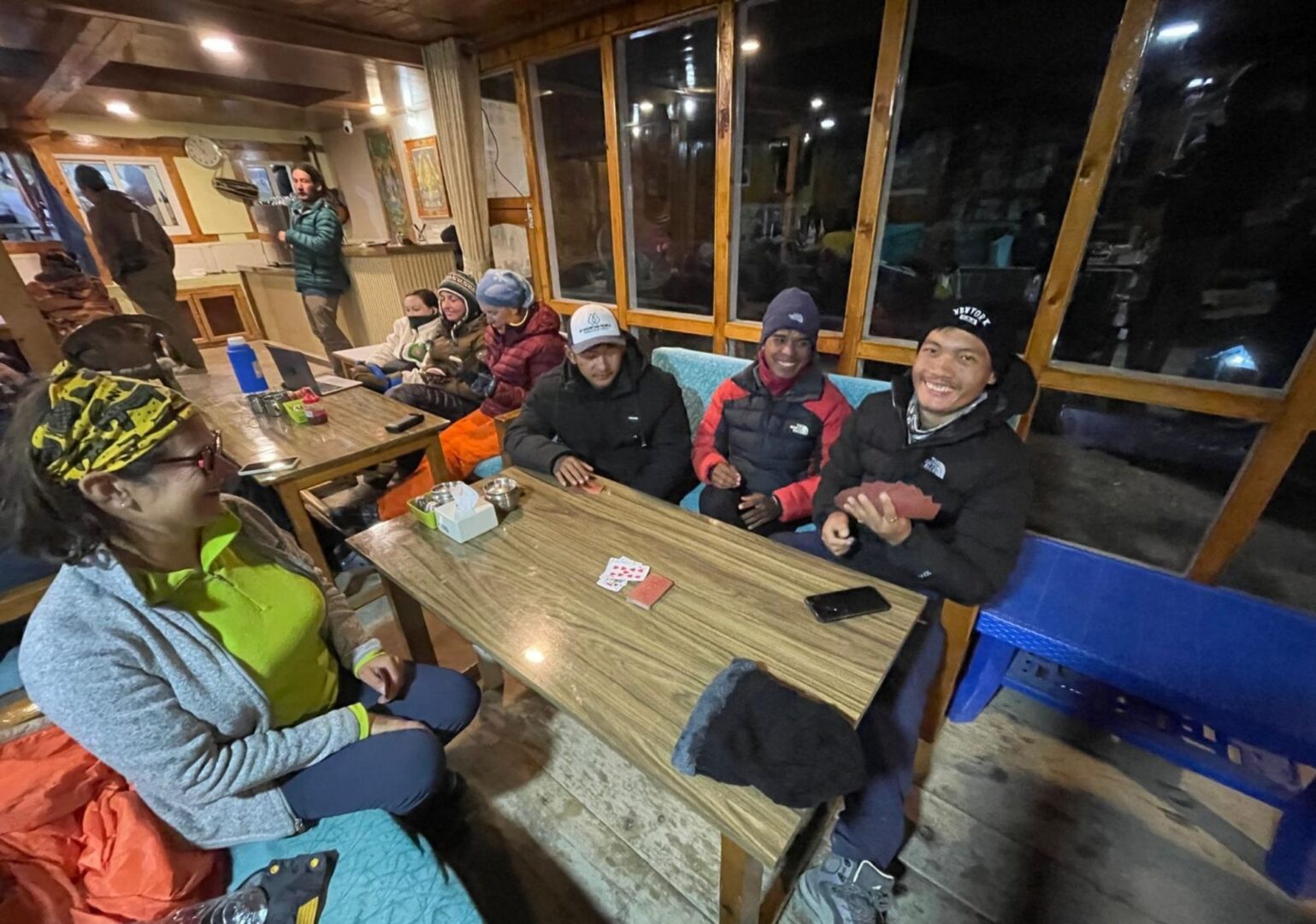
In the morning, we board our jeep to Chamje (1,410 m / 4,626 ft), the starting point of our trekking. The drive takes about 7 to 8 hours. Gradually, the scenery changes: from the bustle of the city to rolling hills, rice terraces, and more rugged nature.

🔓 The Annapurna Circuit opened to the world in 1977
Before 1977, the Annapurna region was closed to foreign trekkers. When the trail finally opened, it quickly became one of the most celebrated trekking routes on earth. The combination of dramatic altitude variation, cultural diversity and raw mountain scenery was unlike anything else available at the time. Nearly five decades later, it still is.
The adventure has begun! We start the trek with a steady climb along the wild Marsyangdi River. After passing through Tal and Dharapani, where the Manaslu and Annapurna routes converge, we hike onward to Bagarchhap (2,160 m / 7,087 ft). A quiet mountain village surrounded by apple trees, dal bhat, and views of snow-capped peaks.


Today, we climb through forests and along the river toward Chame (2,650 m / 8,694 ft). Along the way, we can hear the sound of yak bells, see Annapurna II suddenly loom in the distance, and meet locals with Tibetan roots. In Chame, a small hot spring awaits our tired legs.


💦 Tip! Visit the hot spring
Near the riverside of Chame, surrounded by pine trees, there are small natural hot springs. They're basic and super small, and mostly quiet. If the water level is high enough, it's a nice place to visit and relax.
We start early, following a rugged path through a narrow valley filled with cliffs, forests, and rivers. Crossing suspension bridges, we ascend to Upper Pisang (3,300 m / 10,827 ft), a quiet mountain village of stone houses, a monastery, and magical mountain views.


🏘️ Lower Pisang versus Upper Pisang
Most trekkers follow the lower trail and pass straight through. By climbing to Upper Pisang, you'll get a completely different experience. The two villages lie on the same mountain, but with a height difference of nearly 200 metres. Stone houses, a monastery, and views of Annapurna II. The lower village has guesthouses and a teahouse. The upper village has silence.
Explore Pisang
Pisang is a beautiful place to explore. From your teahouse it’s a small hike to the Monastery. Well worth the visit!

Visit the monastery
The monastery in Upper Pisang dates back around 250 years and is one of the oldest in the Annapurna region. It sits above the village on a ridge, with views that make the climb up worth every step. Inside, butter lamps flicker in front of ancient thangkas. Time moves differently up here.
We hike through the dry, high-altitude Manang district today. This region lies in the rain shadow of the Annapurna massif, which provides clear weather and endless views. We follow one of two routes to Manang (3,540 m / 11,614 ft), situated deep within the impressive high mountains.


Explore Manang
Manang is the capital of the region, so there’s a lot to explore. Want to go for a small walk? Here are some ideas.
Visit the health clinic
The Himalayan Rescue Association (HRA) runs a clinic in Manang where altitude sickness is the main topic. Every afternoon, trekkers can attend a free talk on the symptoms of AMS, what to do when things go wrong, and how to acclimatise safely. Before you head higher, this is worth an hour of your time.
Watch a movie
Manang has a cinema. A real one. Every evening, a trekking film is shown in a small room with wooden benches. It started as a way to keep trekkers entertained on their acclimatisation day. Today it is a small institution on the circuit. Bring popcorn. Or just a snicker.
Send a postcard
Manang has its own post office. At 3,540 m / 11,614 ft, it is one of the highest post offices in the world. You can send a postcard from here to anywhere on the planet. Proof that you were here, at altitude, before the big pass
We take it easy today. No major elevation gain, but plenty of time to acclimatize. If you like, we can go for a short hike. Or, just kick-back and relax in the village.




Day hike
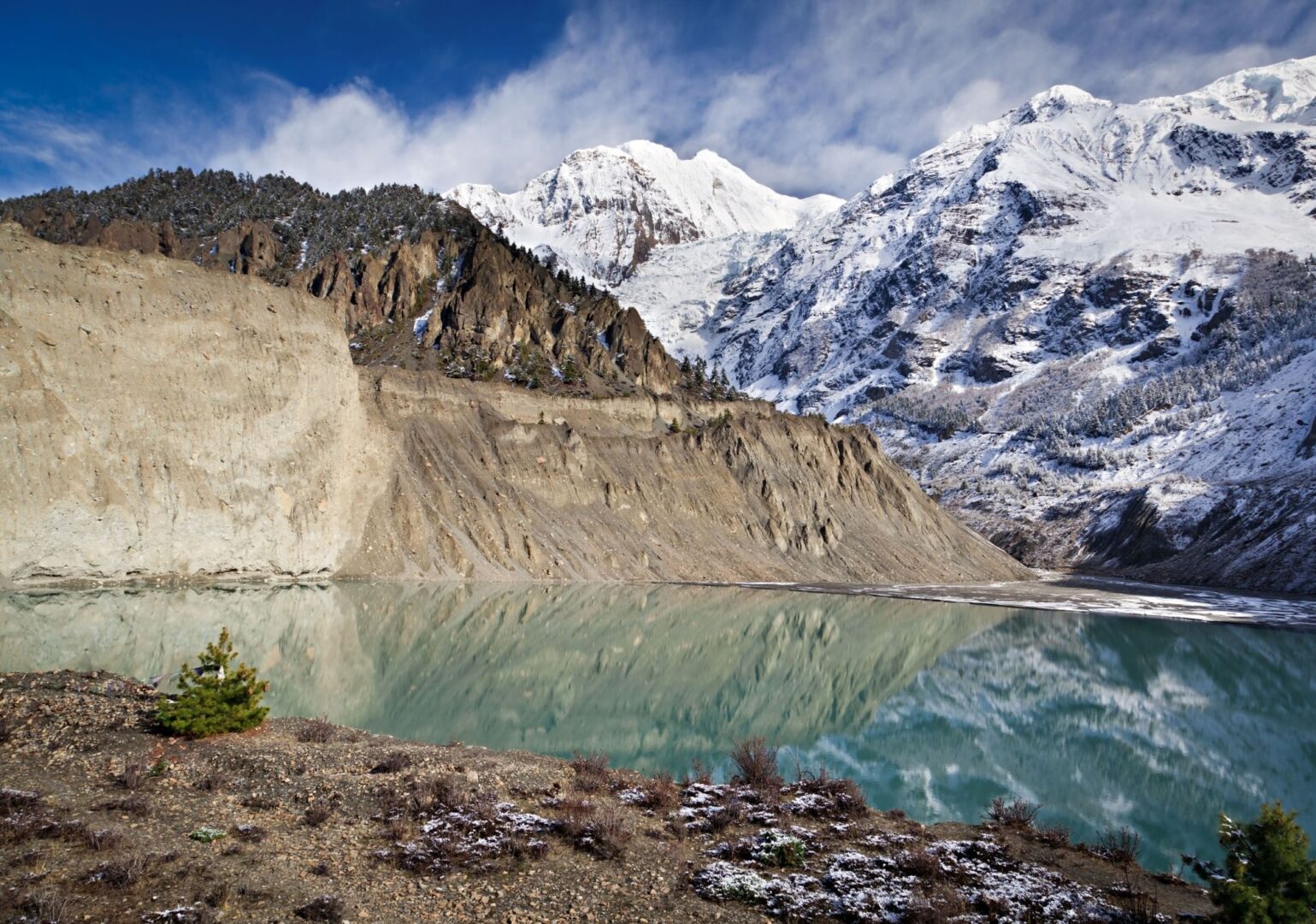
Climb high, sleep low. It helps your body acclimatize. Today, the group can hike to one of these lakes.

Gangapurna Lake
On your acclimatisation day in Manang, there is an optional hike up to Gangapurna Lake. It's located at an altitude of approximately 3,700 meters near the village of Manang.

Ice Lake
Or, the more challenging hike to Ice Lake at around 4,600 m / 15,092 ft. It takes about three to four hours to climb and rewards you with a glacial lake and a panorama over the entire Manang Valley.
After our rest day in Manang, we push on toward Tilicho Lake. We pass the quiet village of Khangsar and climb along rugged slopes. By the end of the day, we reach Shree Kharka: cold, silent, and pure. Time to recharge.
We trek higher into the mountains, passing a deserted monastery and crossing a steep ridge. After an exciting descent, we reach Tilicho Base Camp (4,200 m / 13,780 ft). Raw, silent, and impressive.
Before you crawl into your sleeping bag, we step outside. At 4,150 m / 13,615 ft, far from any city light, the sky above Tilicho Base Camp is vast and uninterrupted. Stars from one ridge to the next … 🤩


🏠 The last teahouse
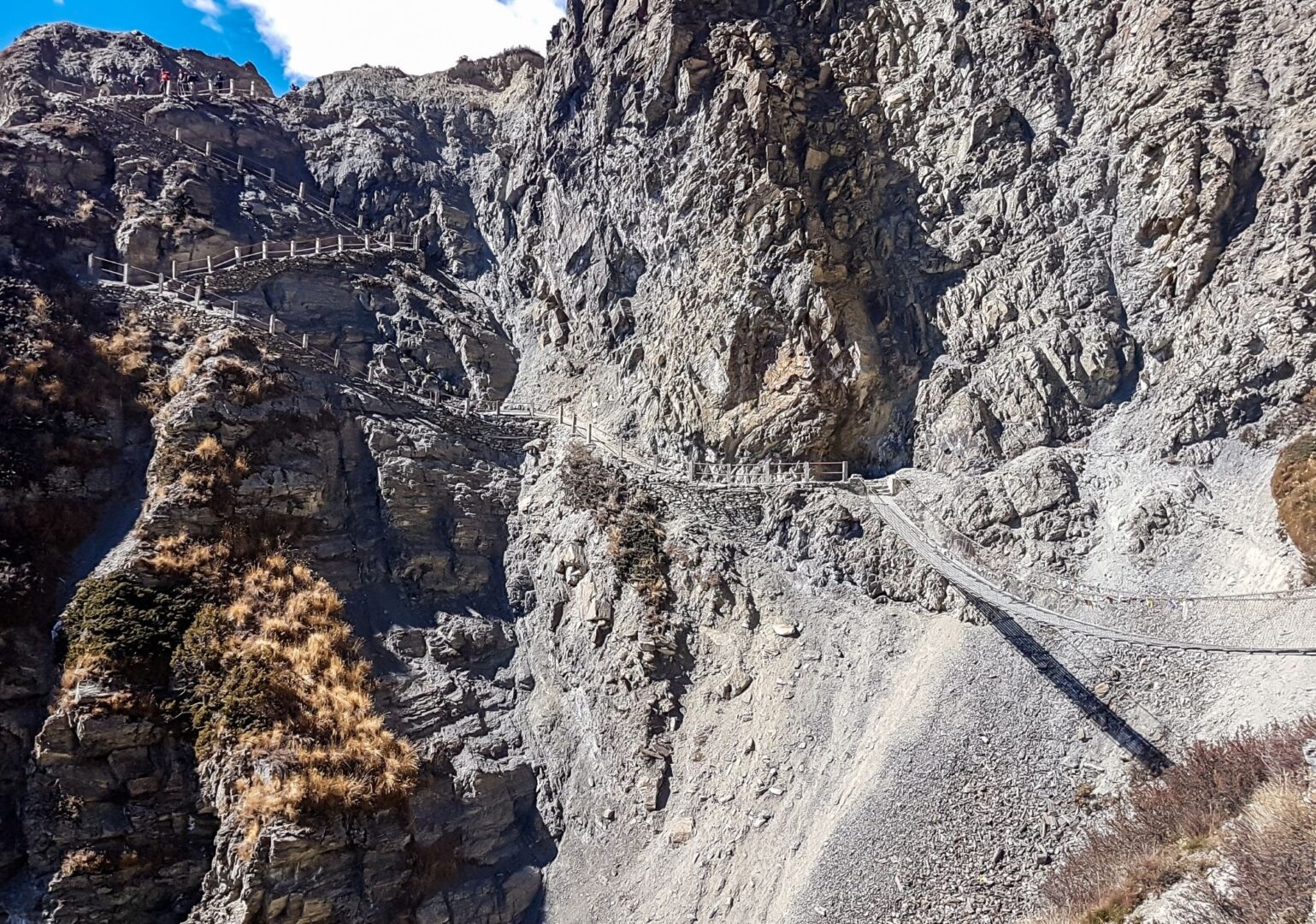
Tilicho Base Camp sits at 4,150 m / 13,615 ft and serves as the overnight stop before the final climb to the lake. There are no teahouses beyond this point, and no accommodation at the lake itself. The base camp exists because the lake is too exposed and too cold to sleep near. What you find here is basic and raw: a few lodges, yak dung fires in the dining room, and a sky full of stars.
We set off early, as the wind picks up quickly here. In about 3 to 4 hours, we climb to Tilicho Lake (4,920 m / 16,141 ft). Ice-blue water surrounded by vast emptiness. Magic. Afterward, we return to Base Camp, where we soak it all in.
🙏🏽 The holy lake
Hindus believe that Tilicho Lake is the ancient Kak Bhusundi Lake, mentioned in the epic Ramayana. The lake is considered sacred to both Hindus and Buddhists, and thousands of pilgrims travel here each year. At 4 km long and 1.2 km wide, it is still the lake with the longest diameter at this altitude in the world. Swimming is not allowed. The water is sacred and freezing.


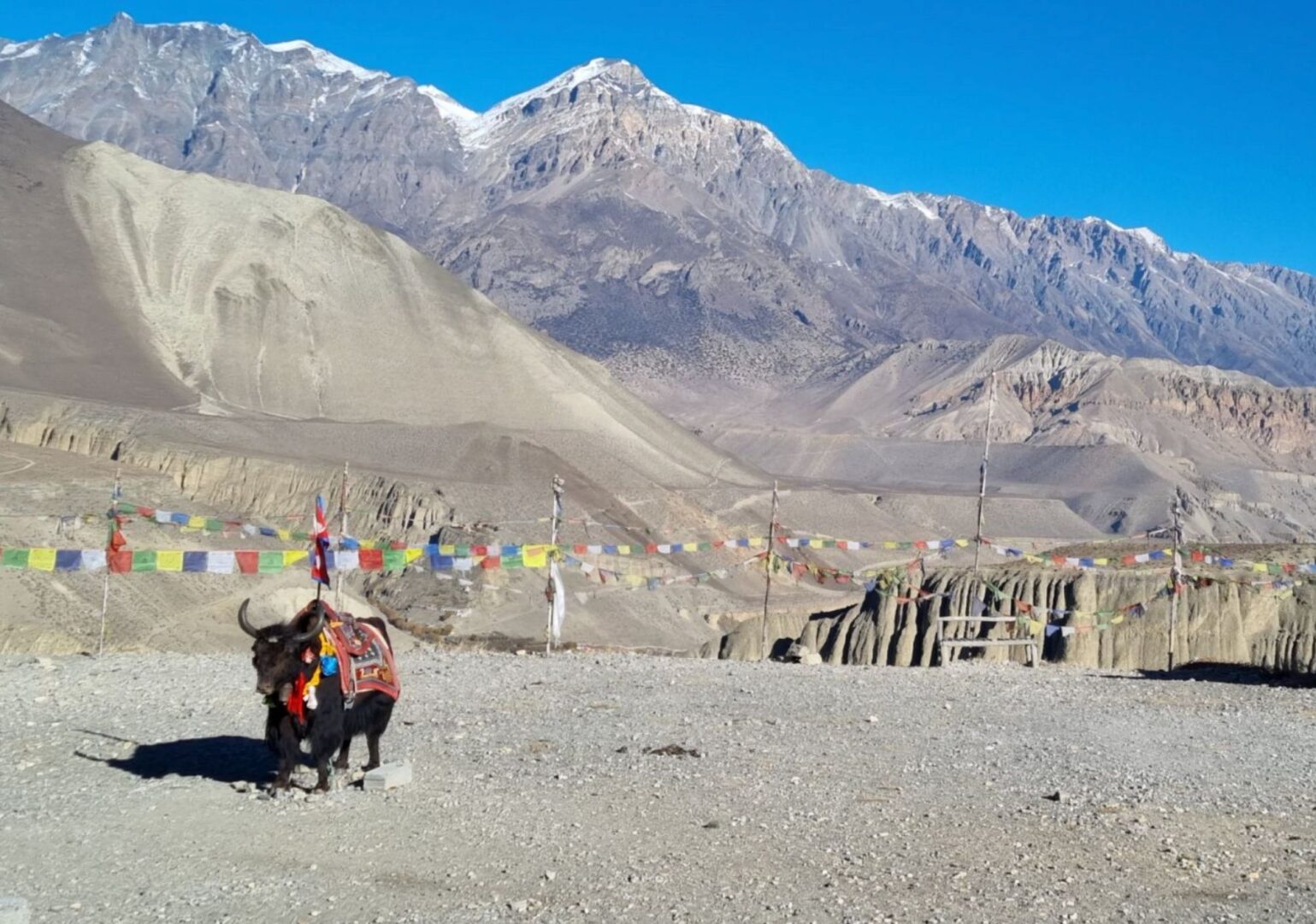
We leave Tilicho and return to the Annapurna route. The path ascends gradually, and the landscape becomes more rugged. Less green, more stone. In the afternoon, we reach Yak Kharka (4,000 m / 13,123 ft), a quiet place amidst yaks, wind, and mountain peaks.

We continue our slow ascent. The air gets thinner, and every step feels heavier. We stop for lunch at Thorong Phedi (4,450 m / 14,600 ft) before climbing further to High Camp (4,850 m / 15,192 ft). Less sleep, perhaps, but a head start on the pass.


Today is the day: we cross the Thorong La (5,416 m / 17,770 ft). Up early, moving slowly but steadily. Every step counts. At the summit, the prayer flags flutter in the wind. We made it!
Afterward, we descend to Muktinath: warm water, more air, and a shared sense of victory.
🙏🏽 Muktinath Temple
Muktinath is one of the only sacred sites in the world revered by both Hindus and Buddhists. For Hindus, it is one of the most important temples of Lord Vishnu and the only one of the 108 Divya Desams located outside India. The outer courtyard has 108 bull-faced water spouts. Pilgrims bathe under each one, the water flows straight off the Himalayas and is shockingly cold. Buddhists know the site as Chumig Gyatsa, meaning "Hundred Waters," and believe that Guru Rinpoche meditated here on his way to Tibet.


Today, we trek down to Kagbeni and then follow the Kali Gandaki river to Jomsom. This is a large town with many facilities. It is also headquarter and official town for the Mustang district, where all the district government offices are present.


⛰️ The deepest gorge on earth
After crossing Thorong La Pass, the route descended into the Kali Gandaki valley, the deepest gorge in the world, deeper than the Grand Canyon. It is carved between two eight-thousanders: Dhaulagiri at 8,167 m / 26,795 ft to the west and Annapurna I at 8,091 m / 26,545 ft to the east. Standing in the valley floor, both summits rise more than 5,500 metres directly above.
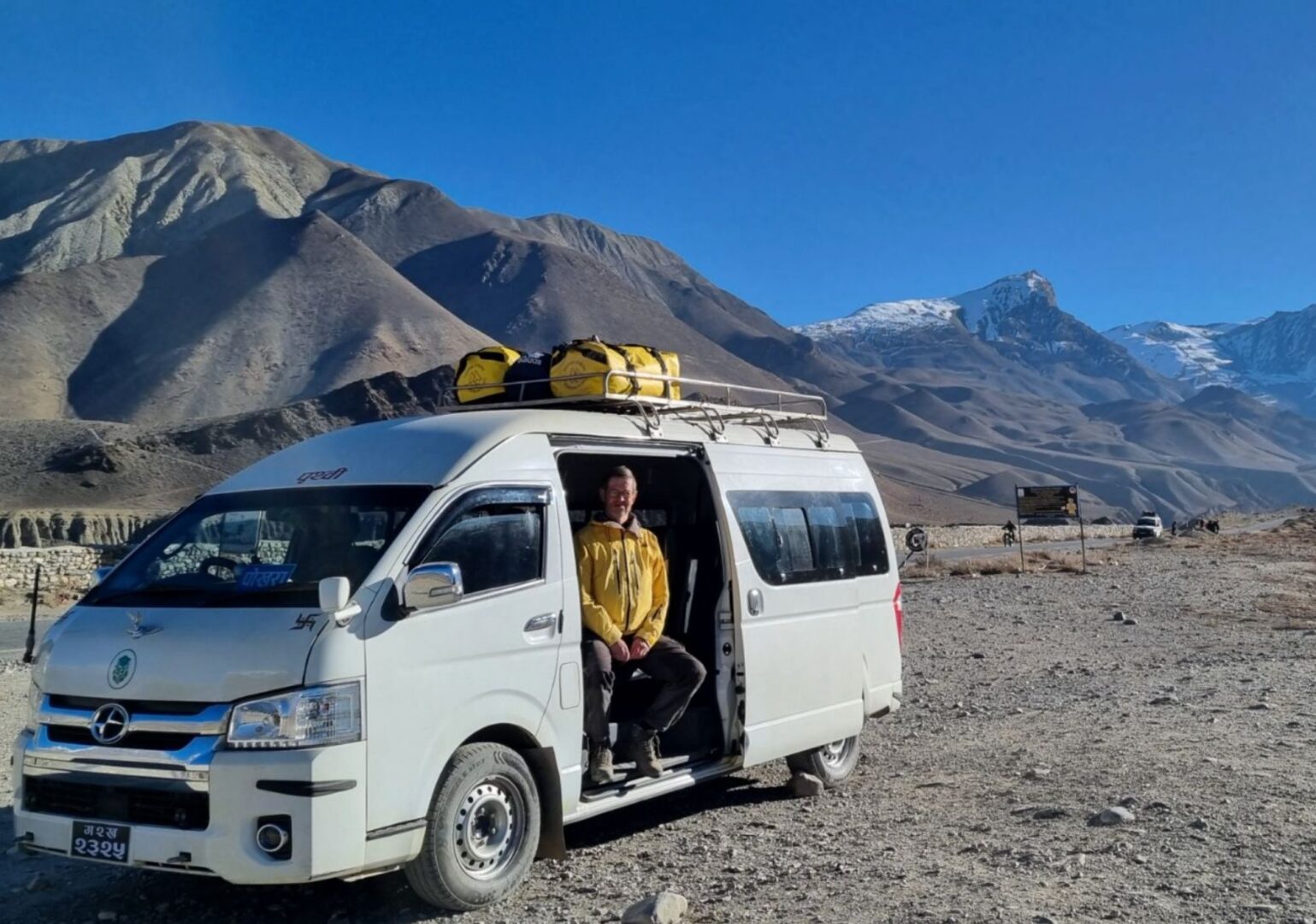
We rise early for the jeep ride to Pokhara. Heading toward warmer air, soft beds, and the silhouette of the Annapurnas reflected in the lake. We’ve reached the Tilicho Lake, and we’ve crossed the Thorong La pass!
Cheers to this beautiful adventure and the memories we’ve made.

Mountains set their own schedule. If we needed an extra dag to cross Thorong La Pass, or if anything else shifted along the way, this extra day gives us the buffer we need.
Everything went smoothly? The day is ours. Explore Lakeside, take a boat out on Phewa Lake or simply sit somewhere with the Annapurnas in view.
We board the bus back to Kathmandu. A long but easy ride through the hills, with the mountains slowly giving way to the valley.
A buffer day in case anything shifted along the way; weather on the pass, a rest day needed, a delayed jeep.
Everything went smoothly? The day is yours.
Sightseeing
Kathmandu is an ancient city with many UNESCO World Heritage Sites. Want to explore the city today? Here are some ideas.

Boudhanath Stupa
One of the largest Buddhist stupas in the world and a UNESCO World Heritage Site. Boudhanath is the spiritual heart of the Tibetan community in Kathmandu. Walking the kora, the circular path around the stupa, alongside monks, pilgrims and locals is an experience that stays with you. The whitewashed dome, the prayer flags and the steady hum of chanting make this place unlike anywhere else in the city.

Bhaktapur Durbar Square
About 13 km east of Kathmandu lies Bhaktapur, a medieval city that feels like it has barely changed in centuries. The Durbar Square is also a UNESCO World Heritage Site and home to the Palace of 55 Windows, the five-story Nyatapola Temple and the ornate Golden Gate. Behind the square, Pottery Square is still a working craft centre where local artisans shape clay by hand, just as they have done for generations.

Pashupatinath Temple
The holiest Hindu temple in Nepal, dedicated to Lord Shiva in his form as Pashupati, protector of animals. The temple complex sits on the banks of the sacred Bagmati River, about 5 km from Thamel. Non-Hindus cannot enter the main temple, but the surrounding complex is open to all. From the eastern bank of the river, you can watch the cremation ghats and the daily rituals that have taken place here for centuries.
Your international flight departs from Tribhuvan International Airport in Kathmandu.
Goodbye friends! We hope you will cherish the memories we’ve made together forever. And see you on the next adventure!
Walking & pace
We usually start the day early. Breakfast is at 7 AM, and we leave the lodge around 8. The morning hours are when the air is freshest and the views are at their clearest.
We stop for lunch towards the end of the morning. Lunch is freshly prepared, warm and unhurried. It can take a while for the food to come out, but that is part of the rhythm. You sit down, drink something, rest your legs and refuel for the afternoon.
In the afternoon, we usually walk a little further to reach the lodge for the night. By around five, we sit down for an early dinner. We order breakfast for the next morning at the same time, so it is ready when we are.
Throughout the day there is plenty of time to drink water, reapply sunscreen, take photos and simply look around. The mountains are not in a hurry, and neither are we.
Route

Altitude

More information
During the Annapurna Circuit Trek with Tilicho Lake, we walk through the heart of the Annapurna region over 13 trekking days, including the detour to Tilicho Lake and the crossing of Thorong La Pass. We walk an average of 6 hours per day. The acclimatisation day in Manang gives our bodies time to adjust before the high section begins. The steepest day is the crossing of Thorong La, which requires an early start and a long descent to Muktinath on the other side.
The trails vary from well-maintained valley paths and stone staircases to exposed high-altitude terrain above 4,000 m. The section to Tilicho Lake and the pass crossing are the most demanding parts of the route.
Quick facts
- Route type: loop with out and back detour to Tilicho Lake
- Total distance: approximately 175 km /109 mi
- Starting point: Chamje (1,410 m / 4,626 ft)
- Highest point: Thorong La Pass (5,416 m / 17,769 ft)
- End point: Jomsom (2,720 m / 8,924 ft)
- Number of trekking days: 13
- Number of rest days: 1
- Highlights along the way:
- Upper Pisang Monastery
- Manang
- Thorong La Pass
- Muktinathi
- Kagbeni
Practical
Everything you need to know before you go. Below you’ll find answers to the most frequently asked questions about the Annapurna Circuit Trek. Can’t find what you’re looking for? Feel free to reach out.
The best preparation is simply walking. Preferably several days in a row, with a backpack and elevation gain. In the months before departure, build up to walking days of 5 to 6 hours. Work on your overall fitness with cardio training (running, cycling, swimming) and don’t neglect your legs: squats, lunges and stair training work wonders.
Just as important: break in your hiking boots in time. New boots in Nepal are a guaranteed recipe for blisters. Ideally, start your training 3 months before departure, or earlier.
Once your booking is confirmed, you’ll receive all the practical information you need to leave well prepared. This includes visa information, recommended vaccinations and a detailed packing list.
After arriving in Kathmandu, there’s a pre-trip meeting with your guide. We go through the route, the latest weather forecasts and there’s plenty of room for any final questions. We also do a gear check, to make sure you have everything you need for the trip. Missing something, or not sure about your gear? We’ll head out together to sort it. Kathmandu has plenty of good outdoor shops. 😉
Possibly.
There may be snow on the way to Tilicho Lake and on the Thorong La Pass. Depending on conditions, crampons or spikes may be required. Your guide will assess the conditions before the ptr-trip meeting and advise. We can arrange rental gear in Kathmandu, if needed.
Altitude sickness can affect anyone. Regardless of age, fitness or experience. Even the most seasoned mountain walkers can struggle with it.
The best prevention is going up slowly. That’s why our itinerary deliberately includes acclimatisation days where needed. This gives your body time to adjust to the altitude.
Drink plenty of water and listen to your body. Headaches, dizziness or nausea are signals to take seriously. Our guides are trained to recognise symptoms and will adjust the programme if necessary.
And if you do get altitude sickness? Descending is the only right choice. No debate, no hesitation. That’s not failure. That’s wisdom.
For more information, read our blog about altitude sickness.
During the Annapurna Circuit Trek you sleep in teahouses: simple mountain lodges with firm mattresses, pillows and blankets against the cold, and dal bhat in the shared dining room.
Expect a twin room, a shared bathroom and cold water. A hot shower or wifi is sometimes possible, usually for a small extra fee. Charging your electronics is always possible, sometimes for a small fee. And then there is the warm fire in the dining room, friendly hospitality and views no hotel can match. This is the Himalaya.
PS: even though pillows and blankets are provided, we recommend bringing your own warm sleeping bag. The nights at altitude get cold, and your own bag makes a real difference. After booking, you’ll receive a detailed packing list that helps you prepare for both the trek and the nights in the lodges.
Yes, always.
The teahouse menu is plant-based by nature and offers plenty of choice. Three warm meals a day are freshly cooked in the teahouse kitchen. Breakfast options include porridge, pancakes, omelette and local bread. For lunch and dinner, expect dal bhat, curry, lentil soup, noodles, dumplings, spring rolls and pasta.
We strongly advise against eating meat on the trail. Ingredients are often carried in on foot and cannot always be kept properly refrigerated. Vegetarian and vegan options are the safer and more reliable choice.
Every group trip includes a porter; one porter per two people. Your porter carries a maximum of 16 kg / 35 lbs in total, which means up to 8 kg / 18 lbs per person.
We provide a duffel bag on loan for the duration of the trek. Everything you do not need during the day goes into the duffel, and your porter takes care of the rest. Our porters often set their own pace and walk ahead, so by the time you arrive at the next teahouse, your bag is usually already waiting for you.
Keep your valuables and anything you need on the trail in your own daypack. Like passports, cash, snacks, water, rain jacket, camera. These items stay with you.
If you feel uncertain about hiring a porter, there is no need to. For porters, this work is the first step towards becoming a guide. They learn the routes from the inside. They gain experience working with international travellers. And they pick up English and other languages along the way. The porter carrying your bag today may well be leading his own group through these mountains in a few years.
Nepal Group Trek – Annapurna Circuit with Tilicho Lake
- A classic high-altitude trek with a special detour: turquoise Tilicho Lake
- Hindu villages, Buddhist monasteries and Tibetan culture in one route
- Cross the legendary Thorong La Pass, one of the highest trekking passes in the world


Nepal Group Trek – Everest Base Camp with Gokyo Lake
Request proposal Ask a question about this group trek

Excited to explore Nepal?
Now let's make it real. Browse our trips or request a quote. We are a small Nepal trekking company, so you will hear from us personally ASAP.

