
Trekking in Nepal
Just walk. Nepal does the rest.


Our own local team on the ground. Dutch certified. The best of both worlds.
By hiring local guides and porters, you help them earn a good income close to home.
Financially protected through VZR Garant and the Calamity Fund.
Why go trekking in Nepal?
Trekking in Nepal means something different depending on where you go. Short routes of a few days. Long circuits of three weeks or more. Low-altitude forest trails with grand views and high passes above 5,000 m. All in one country.Nepal stretches over 800 kilometres from east to west, and no two regions feel the same. The far east is wild, remote and rarely visited. Moving west, deep cultural valleys and high glacial terrain take over. The middle brings lush green hillsides, terraced farmland and dramatic high passes. Further west, the landscape opens up into vast alpine plateaus. And in the far west, the terrain becomes dry, wind-swept and otherworldly.
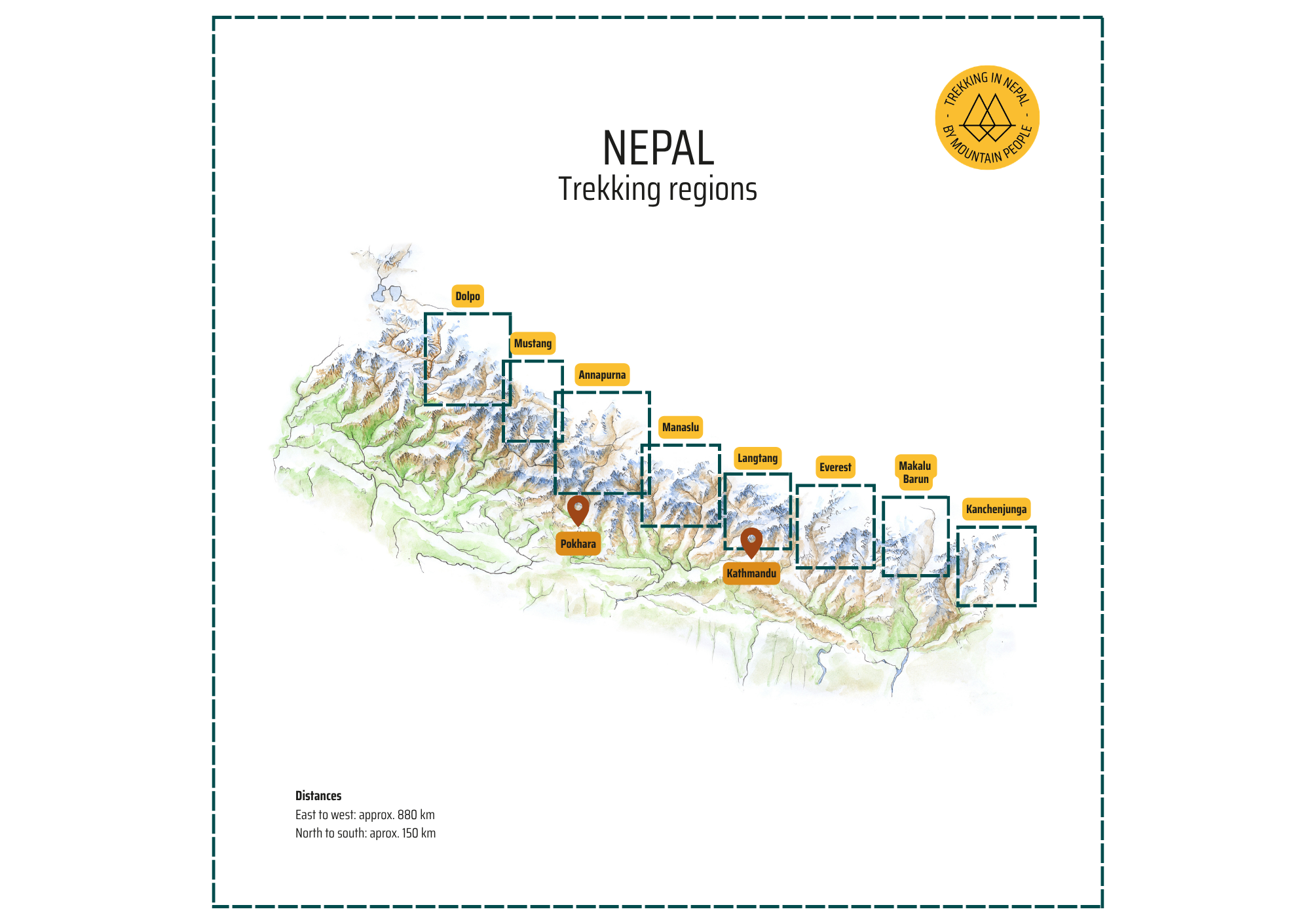
Combine trekking in the mountains with sightseeing in ancient cities and a wildlife safari in the jungle for a complete Nepal experience.
By Mountain People was founded in 2015 by Govinda, who grew up in Nepal, and Valerie, who is Dutch. Govinda knows the trails, the seasons and the people. Valerie makes sure you always know exactly where you stand.
We work with our own team on the ground. No subcontractors, no middlemen. Every trek is protected through VZR Garant and the Calamiteitenfonds.
Routes: find your trek
Whatever kind of trekking in Nepal you’re looking for, you’ll find it here. Join one of our group treks across Nepal. Or explore our individual trips, tailor-made for solo travellers, couples or families.


Preparation
Preparing for trekking in Nepal starts before you land in Kathmandu. A good preparation makes the difference between a trip that challenges you in the right way and one that overwhelms you before you reach the first pass.
Explore all blog postsNepal is not one trek. It is dozens of routes, each with its own rhythm, its own landscape and its own story. With our blog, we take you to the Annapurna region, the Everest foothills, the remote valleys of Dolpo and Mustang, and everywhere in between.
Get inspiration from our blog:

Start your preparation through our blog:

Safety & altitude
Trekking in Nepal happens at altitude, often above 3,000 metres / 9,850 ft. That asks something of your body, regardless of age or experience.
You trek at your own risk. A reasonable level of fitness is required, and it helps to be in good health before you go. If you have any concerns, medical or otherwise, let us know before departure. Once on the trail, talk to your guide. They are trained to recognise the early signs of altitude sickness and will adjust the pace or itinerary if needed.
During the trekking you need to listen to your guide’s instructions. They know the route, the weather and your group’s pace. If they suggest a rest day, a different schedule or turning back, that advice is there to keep you safe.
Want to know more? Read our guide on altitude sickness in Nepal, or find out how to avoid a helicopter rescue during your trek.
Explore all blog postsPractical info
Everything you need to know before you go. Below you’ll find answers to the most frequently asked questions about trekking in Nepal. Can’t find what you’re looking for? Feel free to reach out.
Spring (March to May) and autumn (September to November) are the two main trekking seasons. Both offer stable weather, clear skies and good visibility.
Spring brings rhododendrons in bloom along the lower trails. Autumn is slightly busier but offers the clearest mountain views of the year. Some high-altitude routes, like the Annapurna Circuit, are also possible during the monsoon, as they lie in the rain shadow of the Himalaya.
It depends on the route.
Some treks in Nepal are accessible for complete beginners. So no prior experience needed, just a reasonable level of fitness and a willingness to walk for several hours a day. Others, like the Kangchenjunga Circuit or the Everest Three Passes, definitely require solid prior experience at altitude.
Not sure where you fit? Get in touch and we will give you an honest answer.
Fit enough to walk 4 to 6 hours a day, day after day, with some elevation gain. You do not need to be an athlete. But you do need to be honest about your fitness level.
The best preparation is simple: walk regularly in the months before your trip, preferably with a daypack and some hills involved.
Yes. Nepal is one of the safer travel destinations in Asia.
Crime against tourists is rare. The trekking infrastructure is well-established on the main routes, with teahouses, rescue facilities and experienced guides throughout. The main risks on the trail are altitude-related, which is why acclimatisation and a good guide matter.
Yes. Since April 2023, trekking independently without a licensed guide is no longer permitted in Nepal. A guide is now required for all trekking routes.
Beyond the legal requirement, a good guide adds enormous value: local knowledge, cultural context, language, safety awareness and the kind of experience that no app or guidebook can replace.
It depends on the region.
Most treks require at least a TIMS card (Trekkers’ Information Management System) and a conservation area or national park permit. Restricted areas, like Upper Mustang, Nar Phu and Kangchenjunga, require additional special permits that can only be obtained through a registered trekking agency.
By Mountain People takes care of all permits as part of your trip.
Altitude sickness is a real risk above 2,500 m and can affect anyone. Regardless of age, fitness or prior experience. The only way to prevent it is to ascend gradually and listen to your body.
By Mountain People builds acclimatisation days into every high-altitude itinerary, and our guides are trained to recognise the symptoms. Read our full guide on altitude sickness on the blog.
The essentials: well-worn trekking boots, a good rain jacket, warm layers, a sleeping bag liner and a comfortable daypack. Many items can be rented in Kathmandu or Pokhara if you do not want to bring them from home.
By Mountain People provides you with a detailed packing list when you book a trek with us.
The cost depends on the route, the duration and what is included.
- Our custom trips are priced based on your specific itinerary
- Our group trips have a fixed price per person, clearly listed on the trip page
Simple, warm and welcoming. Teahouses in Nepal are small family-run lodges where you sleep in a twin room with basic bedding and eat freshly cooked meals three times a day.
On the main routes in Everest, Annapurna and Langtang, facilities are generally good, with hot showers available at most stops.
On more remote routes, expect more basic conditions. Dal bhat, the classic Nepali dish of rice, lentils and vegetables, is always available, always freshly cooked and always good.

Excited about our trips to Nepal? Reach out via the buttons below. We're ready to help.
Send a Whatsapp message Call us on +31 6 87 54 22 50Small group trekking in Nepal
Planning a trekking trip in Nepal, but not looking to go it alone or end up in a large anonymous group? Our group treks are kept deliberately small, so the experience stays personal. A certified local guide who knows the mountains, a porter to carry the heavy bag and a complete trip from arrival to departure. No logistics, no permit stress, no organising teahouses from behind a laptop. Just show up and walk.

The routes cover the full range. Popular trails like the Annapurna Circuit and the Everest Base Camp trek. Off the beaten track circuits around Manaslu and Kangchenjunga. Accessible trails for first-time trekkers and high-altitude challenges for experienced walkers. Hotel nights in Kathmandu, all transfers and all permits included.
Individual trekking in Nepal: tailor-made
The route, the duration and the level of challenge are entirely yours to decide. With an individual trip, everything is built around your wishes. Travelling solo, as a couple, with friends, family or a private group. A short trek only, or a complete Nepal journey that combines mountains with Kathmandu, Pokhara or a jungle safari in Chitwan. A relaxed family trek with children, or a serious high-altitude circuit above 5,000 m.

Browse our suggested itineraries for inspiration, or tell us what you have in mind. A certified local guide is always included. Personal contact before and during your trip, always. And full flexibility, including when plans change on the road.
Excited to explore Nepal?
Now let's make it real. Browse our trips or request a quote. We are a small Nepal trekking company, so you will hear from us personally ASAP.

