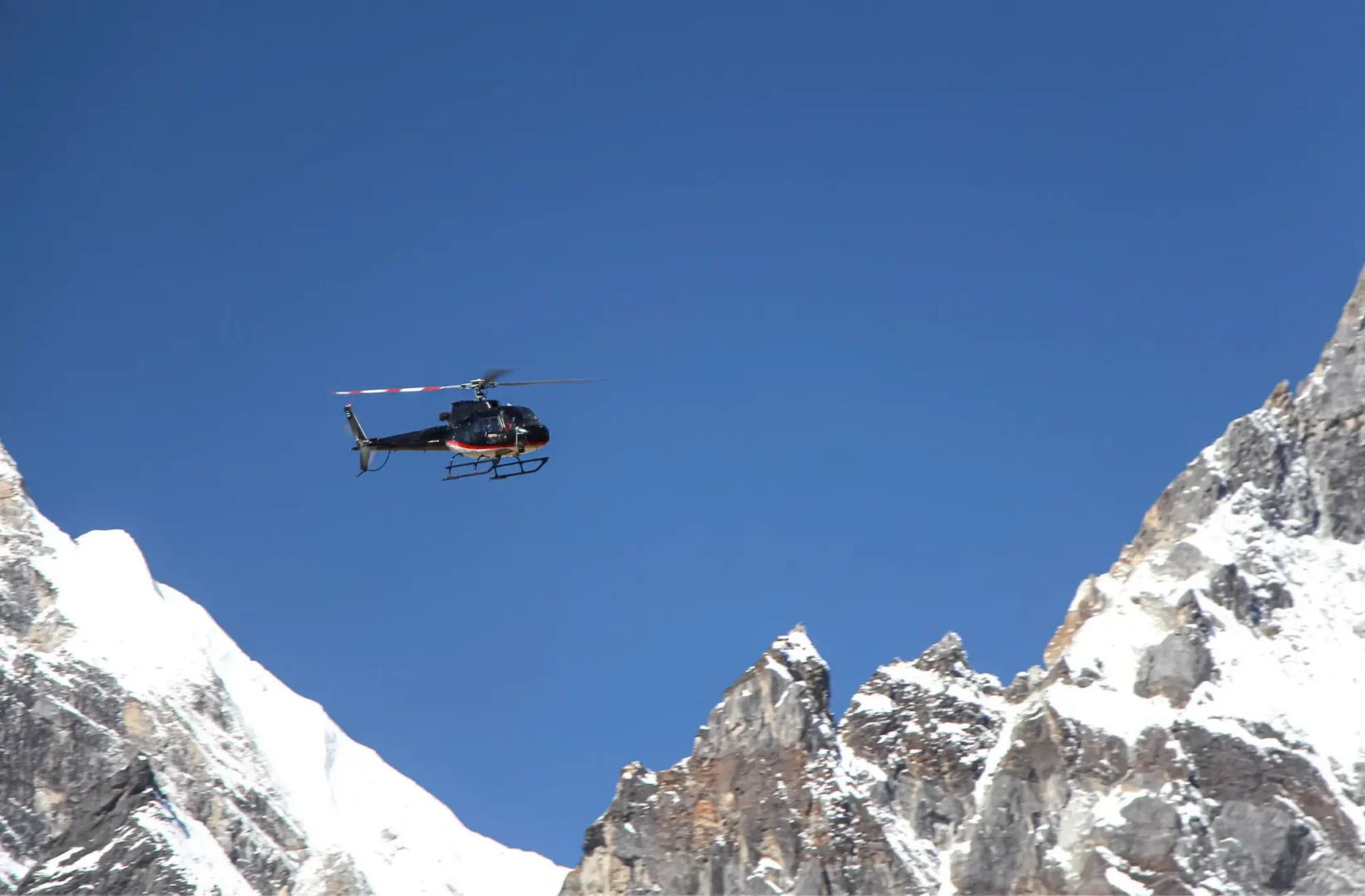
Helicopter Rescue Nepal: How to Avoid It on Your Trek?
If you’re planning a trek in Nepal, this is something worth knowing. Helicopter rescues happen every trekking season, and not always for the right reasons. If you search online on “helicopter rescue Nepal” you’ll find numerous news articles about early 2026, when nine people were arrested in Nepal for faking helicopter rescues. But the real story goes deeper than the scam itself.
In many cases, an unnecessary evacuation doesn’t start with fraud. It starts with poor planning.
How do fake helicopter rescues actually start?
Large groups with only one guide, or climbing to high altitude too fast. Unrealistic itineraries that don’t allow enough time to acclimatise. Groups eating at lodges where hygiene is insufficient, or ordering dishes you simply shouldn’t eat in remote areas. Meat, for example, is often transported on foot to high-altitude lodges, without refrigeration. The risks are real.
The ratio of guides to trekkers matters too. A single guide responsible for a large group cannot monitor everyone closely enough at altitude. When something goes wrong, the pressure to act fast, rather than act right, increases significantly.
When things go wrong in these situations, guides often have only one option: call a helicopter. And that’s where it gets complicated. Some travel organisations own their own helicopters and clinics, and profit directly from every evacuation. In some cases, the rescue wasn’t even necessary in the first place.
One more thing worth knowing: many international travel organisations don’t run their own trips at all. They sell the journey, but hand the execution over to a local operator. And the lines of responsibility become blurred.
How to protect yourself
There are 5 things you can do:
- Know the symptoms of Acute Mountain Sickness (AMS). It develops gradually as you gain altitude. It doesn’t suddenly hit you after a meal. Symptoms include headache, nausea, dizziness and fatigue. If you recognise them early and communicate with your guide, the solution is usually simple: rest, hydrate, or descend slightly.
- Choose your organisation carefully, and check whether the local travel company executing your trip is registered with TAAN (Trekking Agencies’ Association of Nepal). TAAN sets minimum standards for licensed guides, safety protocols and responsible trekking practices. Registration is not a guarantee, but its absence is a red flag.
- Ask whether your guide holds an official trekking license.
- Look for verifiable reviews. Not just on their own website, but especially on independent platforms.
- Pay attention to how the organisation communicates. A reliable company has no trouble answering specific questions about safety, emergency protocols and what happens when the weather turns.
It’s also important to check your insurance. Not all travel insurance policies cover trekking in Nepal. Some offer limited coverage at higher altitude or in remote areas. Check your policy before you leave, and make sure it explicitly covers high-altitude trekking and emergency evacuation in Nepal.
Most policies define high altitude as above 4,000 or 5,000 metres. Some exclude helicopter evacuation unless it is deemed medically necessary by a certified professional on the ground. Read the fine print before you leave, not after something goes wrong.
How By Mountain People prevents helicopter rescues in Nepal
By Mountain People is both a local Nepali and a registered Dutch travel company, connected to VvKR (Association of Small-scale Travel Specialists, Vereniging van Kleinschalige Reisorganisaties) and backed by the guarantee fund VZR Garant. That means you have the security of a recognized European travel organisation, combined with the local knowledge and network of a team that has been working in these mountains for years.
We don’t outsource. We have our own execution team in Nepal, are registered at TAAN, with guides and porters we know personally, work with for years and trust completely. Short lines, high standards.
With By Mountain People, you either trek with your own private guide, or join one of our small groups. The group trips are never more than 10 people, and always with two guides when groups are larger. Our itineraries are built around proper acclimatisation, not speed. Before you head into the mountains, your guide checks your gear, briefs you on food safety and makes sure you know what to expect.
The real test comes when things don’t go as planned
In October 2025, an unexpected storm hit the Himalayas in the middle of peak season. Entire areas were closed, flights delayed, rescue teams deployed. At By Mountain People, we had several groups out on the trails at the time. And every single person was brought to safety. Some returned to Kathmandu or Pokhara, others completed their trek via an adjusted route.
Not one of our groups needed a helicopter evacuation. Not during the storm, and not at any point during the rest of 2025.
“Thanks to Govinda’s quick response, we found a new route towards ABC (Annapurna Base Camp).” – Serge
“Govinda had his head on a swivel and facilitated an alternative over the course of one morning, allowing us to experience the awesomeness of the Himalayas, instead of getting stuck in a closed off region.” – Jeffrey
Trekking safely in Nepal: the bigger picture
These scams damage the reputation of an entire industry, one that is largely built on honest, hard-working people. The guides who get up before dawn. The porters who carry heavy loads at altitude. The teahouse owners who open their doors to strangers every single day. They deserve better than to be associated with the actions of a dishonest few.
Nepal remains one of the most beautiful trekking destinations in the world. Go well prepared, choose wisely, and you’ll have nothing to worry about.
Curious about how we work? We’d love to tell you more.
Or read more about trekking in Nepal or learn how to recognise and prevent altitude sickness on your trek.
Get in touch